66 Days (and Why Missing One Doesn't Matter)
You've probably heard that it takes 21 days to build a habit. So when day 22 comes and your new routine still feels like work, it's easy to think you're doing something wrong.
You're not. The research tells a different, much kinder story: habits take time to build, and one missed day doesn't erase your progress.
What the research says
In a 2010 study from University College London, researcher Phillippa Lally and her team followed about 100 people as they each built a new daily habit, like drinking water with lunch or going for a short walk. They tracked how long it took for each habit to feel automatic.
Three findings stand out:
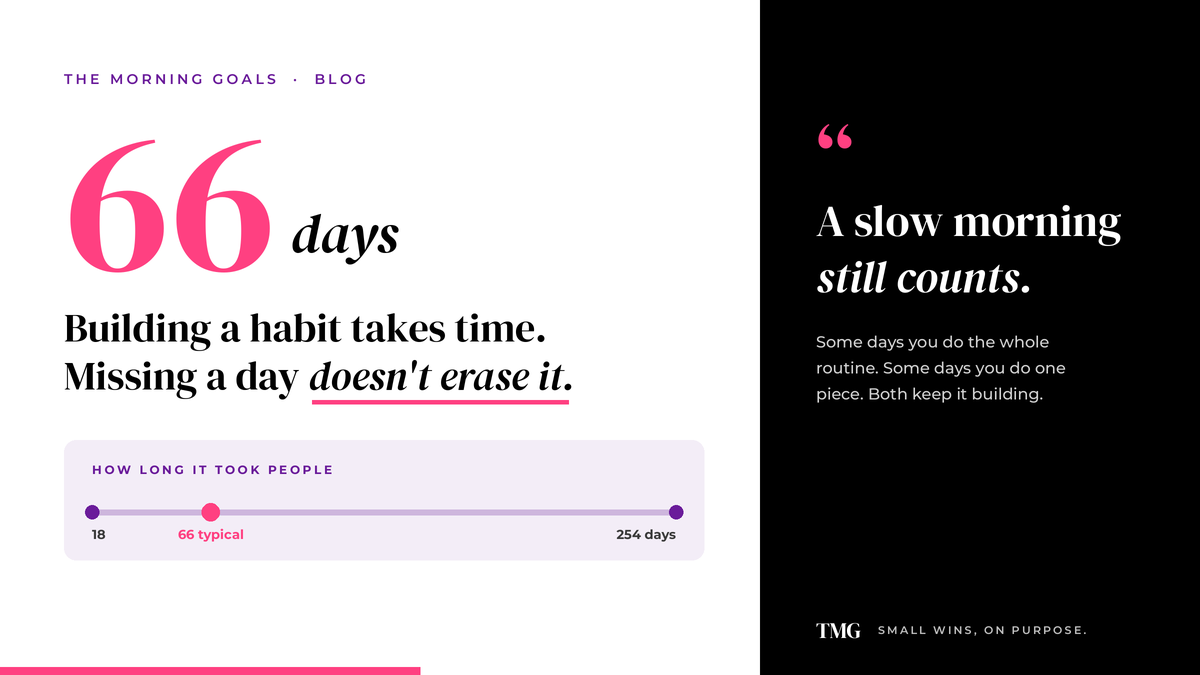
- About 66 days. That's how long it took a typical person for their new habit to feel automatic. That's more than two months, not three weeks.
- Anywhere from 18 to 254 days. Everyone's timeline was different. Simple habits came faster, and harder ones took longer.
- One missed day didn't set people back. Skipping a single day didn't meaningfully affect how the habit formed. What mattered was coming back to it.
Why this matters for neurospicy brains
If you have a neurospicy brain, all-or-nothing thinking can be a real trap. Miss one morning and it can feel like the whole routine is ruined, so why bother?
The research says otherwise. A missed day is just a missed day. Your progress is still there, waiting for you to pick it back up.
A slow morning still counts
Some days you'll do the whole routine. Some days you'll do one piece of it, like drinking a glass of water and writing down your first task. Both count. Showing up in a small way keeps the habit building, even when the day doesn't go to plan.
Three ways to stay patient with your routine:
- Have a "minimum version." Decide ahead of time what the smallest version of your routine looks like, so you have something to fall back on during hard days.
- Never miss twice. One missed day is fine. Make the next day your comeback, even if it's just the minimum.
- Track it on paper. Seeing a week of check marks, even imperfect ones, is a powerful reminder that it's working.
What it looks like with support
Here's how one client described working with The Morning Goals:
"The Morning Goals helped me come up with a weekly plan that helps me get up, get going and make progress, breaks included." — Barbara, Newton, MA
Breaks included. That's the point. Be patient with your routine. It's building, even on the slow days.
Set up your week
My Week Guide is an easy way to track your progress on paper. Print it on Sunday, choose what matters most and check off each day you show up, even in a small way.
Want help building a routine that fits?
That's what coaching at The Morning Goals is all about. Together, we'll figure out how your brain works best and build a plan around it, one small win at a time.
— Edward
Source: Lally, P., van Jaarsveld, C. H. M., Potts, H. W. W., & Wardle, J. (2010). How are habits formed: Modelling habit formation in the real world. European Journal of Social Psychology, 40(6), 998–1009.
Want a system that fits your brain?
Start with a free 30-minute discovery call.